Gender and Sexuality in War

Gender and Sexuality in War

Friday, February 26, 2016

Fact: Men Experience Sexual Harassment Too


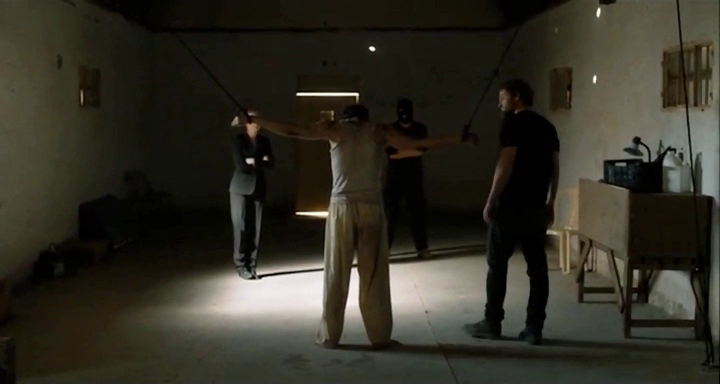
Throughout the course I have tried to relate all of my topics centered on the theme of sexuality and gender in war, and one thing that came to mind while determining how to end this post was our lecture in torture, this picture in particular:

*sensitive content below*


Sexual harassment is often something associated with women, we seem to ignore the fact that men can be victims of this source of abuse as well, let alone it is never assumed that a woman is performing this type of torment.  

It was shocking to me to see this photo, only because I would have never thought a woman would perform in an action that is too often performed on women themselves. Terrorism is too often limited to physical acts and are never linked to emotional trauma.

Elaine Scarry says that “sexuality” is a source of power, asserting a certain dominance allows someone to believe their power has enhanced. In Professor Lazo’s lecture on Barbarians and barbarianism there are recorded accounts of men who were tormented through sexual assault/harassment and describe what has happened to them.

It was also alarming how shocked I was that I had never heard of this treatment before. Sexual harassment toward men is so rarely talked about that it’s extremely difficult to comprehend that it actually happens, and in a way that is traumatizing, in the same way it happens to women.

I believe that this is a “gender norm”, or a socially constructed idea, that men cannot experience sexual assault. Men are portrayed as too masculine and are labeled with stereotypes that contradicts the idea that they can be a target of assault.

It’s disappointing that issues that happen every day and can happen at any moment are overlooked because of certain stereotypes or because society sees them as a non-normality.

Friday, February 19, 2016

OpEd: Torture in Entertainment


In entertainment, the term "torture" is used very loosely. It is used as a form of comedy in games like Grand Theft Auto, it is seen as a motivation in movies like Deadpool, and it is spoken on very lightly. While this may be seen now as a “social-norm”, in its literal context, it is far from “normal”.


In movies, torture is taken in a more literal sense and shines its true meaning. Its heaviness is shown in movies like Deadpool and Zero Dark Thirty, in the sense that they show the depth and brutality of this act in these cinematic art forms.


In video games like Grand Theft Auto, it is portrayed as humorous and also as a necessity. Torture in video games, I feel, can be seen as more dangerous than that in movies. While movies are influential, most of these have ratings and they then give off warning that the material might be too traumatizing in some sense for a child under the age of eighteen. Video games, while some have an age limit, can be bought and re-gifted to any age.


Also, in most video games like GTA, the player is the narrator and can execute any action he/she desires. In GTA, you are the one in charge, which can be influential to the young audience that plays this game.


While there are more than just this one issue in the sorts of video games, this one is the most controversial, it takes a vulnerable global issue and plays it as a mockery and displays it as a comical scenario.

It can be argued that games like these aren’t meant to target younger audiences, however, regardless of age, torture should not be a term or situation taken lightly or used to produce or allude to comedy, nor should it be expressed as something that is normal or necessary in any circumstance.

Source(s): Deadpool Zero Dark Thirty GTA

Torture: Is There A Difference Between Terrorism and Torture?

Torture, in any case, should be seen as drastic and inhuman. When I think of the term "torture", I also hear the word "hypocrisy". Why "punish" a person performing a criminal act by performing something more repulsive? To justify torture would mean to justify the act the criminal has done.


Like in math: if A = B and B = C, then A must equal C.


To break this down even more, let's use Dershowitz's example: if (A) a terrorist were to implement the "Ticking Time Bomb" scenario, this automatically classifies them as what is defined in (B) "terrorism" (side note: terrorism is the use of violence and intimidation in a pursuit of political aims). If terrorism is displayed by violence and intimidation, and the term (C) torture is defined as inflicting pain (in violent acts, e.g.: beatings, branding, electric shocks, etc.), then what makes them different?


The outcome: A terrorist = terrorism, terrorism = torture, then wouldn't a terrorist = torture?


The people in these images seem to think so:


Another example that makes this theory seem true, although fiction, in Batman: The Dark Night, it is easy to see the Joker as a terrorist. He roams around Gotham city in an attempt to cause chaos and terrorize a whole town. There is a scene in the movie where Batman is in the interrogation room with the Joker and while they are speaking, Batman uses his intimidating low, powerful voice to extract information from the Joker.


In this scene the Joker pushes one too many buttons with Batman and results in Batman using force, brutally beating him up. He throws him against the wall, smashes him on a table, and blocks the door when an officer chief tries to intervene on the attack, others seeing the line Batman has crossed and even sensing small fear. We see the Joker as the victim, almost, when he finally gives Batman the information he needs after being broken down from harsh treatment.


From my standpoint, I see Batman as the terrorist, using his power to prevent anyone from stopping him from harassing the information from the Joker. The Joker is A, his acts on the town is B, and Batman is C. Was Batman any more human or any less harmful than the Joker?

Terrorism in any way or circumstance should be seen as hypocritical and inhuman.

Monday, February 8, 2016

Women Belong in the House and the Senate

It's no surprise that women were encouraged, if not forced, to limit their participation in anything else that didn't involve being inside of a house cooking, cleaning, sewing or just tending to her husband and raising their children.

Before the civil war, "true womanhood" was painted to illustrate a women's role in society. A "True" woman devoted her time and self to maintaining a clean home and working to satisfy her husband and to nurture her children.


But, desperate times call for desperate measures - which, in this case, means letting women off the leash (restriction) society at the time had placed them in.

Women were seen more outside of the home, working as nurses during the Civil War. But, word of having to nurture and care for more men didn't seem to satisfy all women. More than 400 women disguised themselves as men to fight in Union and Confederate Armies during this time.

Sound familiar?

Yes, Mulan disguised herself to protect her father, but the same idea still applies. Mulan felt she did not fit the societal-driven category she was mandatorily placed in. Before volunteering, she did not see herself performing as a traditional woman in her culture.

The tradition of women not being limited to home-based activites continued throughout the years involving war.

In World War II, women were needed to take over the jobs men vacated because of war recruitment.

Even in these desperate times, employers were still hesitant to hire women for what was seen as a "man's job". It wasn't until an introduction of conscription in 1916 that made hiring women urgent.

It has always been a war between women and societies view of women and their expectations of us. Even when women were needed (in war especially), manufacturers and corporations were still reluctant in hiring women because of the stereotypical atmosphere and thinking that has been permanently strewed into our heads, including the idea that women are weak or are too emotional to be involved in such social issues.

But, time and time again, we have proved to be more than capable, and we will continue to prove this, not for the approval of society, but for the satisfaction for ourselves.

Sources: Women in the Civil War, Women's Work in WWI

Friday, January 8, 2016

The Civil War: Women's Involvement


With the new quarter starting, and new books being read, I’ve considered changing the theme of my blog quite a few times, but decided against doing so because I felt this topic deemed very relevant with this particular war.

During our last lecture, we came across various influential women that were present through the civil war that obtained very little recognition, we even came across paintings/pictures of women that were dehumanized. One example being the picture that excluded the only woman in it when posted in a newspaper:

   
                                                      Forbes, Edwin, 1839-1895, artist

                            (http://hcc.humanities.uci.edu/humcore/Student/gallery/index.html)


Professor Fahs went on to say that this was a mechanism to display that women needed to always be under the power of men.
One other thing that sparked my interest was the ad that was put out for Harriet Jacobs:
http://www.pbs.org/wgbh/aia/part4/4h1541b.html


It was very alarming for me to see this, mostly because, in that time, African-American’s were seen as property, so much in a sense that I just assumed they meant little to nothing to the owners. But, upon seeing such a serious documentation of a missing slave, it made me think that Harriet Jacobs’ “master” sent out an ad specifically in regard to her, mainly because of the physical attraction he held for her.
It is to my understanding that because the slaves were treated with such degradation and seen as property that the owners would have every right to do as they pleased with whomever they pleased. I may be mistaken and may have misinterpreted the rules of slave-to-master, but if this were the case, I assume that her master had seen Harriet as more than a slave.
Not to say that I believe the owner held infatuation with Harriet, or loved her in any way, but it is suspicious of what he thought of the rest of the slaves on his plantation. If it were any other slave, would he had sent out an ad for them, too? Would any other slave holder send out that ad?


Wednesday, November 18, 2015

War From Above vs. War From Below

The idea of "below versus above" is an interesting concept. In The Iliad, (the main) women are goddesses. In pictures we have seen, most of them are depicted or drawn sexually and wrote out to be manipulative. In Mother Courage and Her Children, women are treated more brutally. Courage struggles for money and struggles to keep her family a priority, her daughter is a mute, not able to speak for herself and is raped in the novel, and this play is seen as "war from below".

Although the terms are classified more commonly with class rather than gender, I believe we can see them from both ways. While in The Iliad, because women are placed in a higher power, they are more demanding, mischievous and manipulative. The way they are drawn out/portrayed are as sexual symbols and threats to men. Whereas in plays and/or novels, such as Mother Courage and Her Children, women from a more belittled background are depicted as crazy or selfish.

Men, in both works used as examples, are more passionate and driven in their duties and are determined and feared and loved by others. They are strong-willed and seen as idols. Although the goddesses in The Iliad are depicted as stronger women, and in special cases seen with a heavier pull with decisions (Hera over Zeus), it still does not diminish the fact that they must be drawn out to be a sex symbol in order to be seen as significant to the reader(s).

Friday, November 13, 2015

Theater vs Literature

In Mother Courage and Her Children there is a scene where Courage and is warning off the commanders from her eldest son. In theater we see the humor of the scene and we do not fail to laugh, though when I read the scene, I felt almost sorry for Courage.

I feel she is an internally conflicted person and, especially because she is in a dire state of money, people are quick to label her as an ironically, mentally "ill" character - or crazy - because, not the sole fact, that she is a woman. In other works (A Streetcar Named Desire by Tennessee Williams), it is easy to see the woman as "crazy" than to think she may actually have something internally wrong with her. I also feel that courage has a deeper struggle than what readers want to believe, or what the author leads readers to see.

The live version of the play is already distracting enough. There are scenes happening at the same time and the audience is faced with decided which act to pay attention to. Detail can be missed in the play, where as while reading it, you are able to refer back to the text if you misinterpreted something or missed a slight detail.